
Analysis as of 23 November 2026.
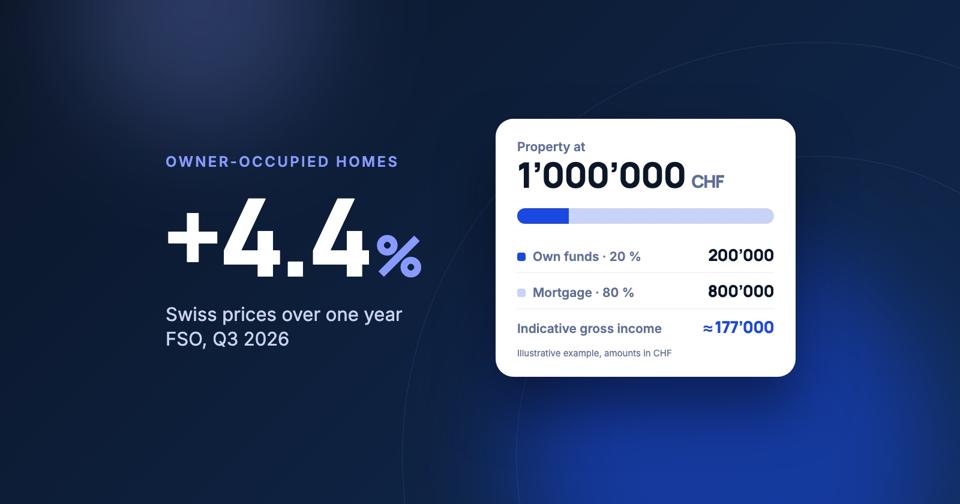
Prices of owner-occupied homes rose by 4.4 % in one year in Switzerland, according to the Federal Statistical Office (FSO). For a buyer, this means more own funds to gather and a higher income to justify. The good news: the calculation rules are simple, and you can check your budget in a few minutes, even before the first viewing.
By how much have prices risen in 2026?
Two recent measures point in the same direction.
The official FSO index (press release of 27 October 2026) shows, for the 3rd quarter of 2026:
- a rise of 1.7 % over three months and of 4.4 % over one year;
- single-family houses up 2.1 % over the quarter;
- owner-occupied flats up 1.3 % over the quarter.
The Raiffeisen transaction price index (press release of 12 October 2026) confirms the trend:
| Type of property | Rise over 3 months | Rise over 1 year |
|---|---|---|
| Single-family houses | 2.0 % | 3.6 % |
| Owner-occupied flats (condominiums) | 1.7 % | 5.9 % |
Please note: these are national averages. The differences between regions are large. According to Raiffeisen, flats rose by only 0.4 % in one year in the Lake Geneva region, while houses rose by 4.6 % in western Switzerland.
Why are prices still rising?
The main reason is simple: there are few properties for sale and many buyers. Raiffeisen stresses that supply remains limited and that the slight rise in fixed rates this summer was not enough to slow prices down.
Rates do remain low. On 23 November 2026, our Taux Radar shows an average of 1.95 % for a 10-year fixed mortgage and 1.80 % for 5 years. Indicative rates, not contractual, averages of the rates published by the lenders tracked. The rate you obtain depends on your file and on the lender’s acceptance. You can follow these averages on our mortgage rates page.
How much own funds do you need to buy?
For a primary home, the rule comes down to three points:
- At least 20 % of the price must come from your own funds.
- Half of these own funds, that is 10 % of the price, must come from somewhere other than your second pillar: savings, pillar 3a, a gift, an advance on inheritance.
- Purchase costs come on top: notary, property transfer tax, land register. They vary strongly between cantons and can reach about 5 % of the price.
To go further, see our complete guide to buying property in Switzerland.
What income do you need to buy?
The lender does not calculate with today’s rate. It checks that you could bear a sharp rise in rates. This is called affordability. It adds up three imputed amounts:
- Interest calculated at 5 % on the debt, even if the actual rate is close to 2 %.
- Maintenance costs of 1 % of the value of the property per year.
- Amortisation: the part of the debt above two thirds of the value of the property must be repaid within 15 years.
The total must stay around a third of your gross income. The exact threshold varies between lenders.
Example: what budget for a property at 1 million?
Illustrative example, for a primary home at 1’000’000 CHF.
| Item | Amount |
|---|---|
| Own funds (20 %) | 200’000 CHF, of which at least 100’000 CHF from outside the second pillar |
| Purchase costs (assumption of 5 %) | 50’000 CHF |
| Total to gather | 250’000 CHF |
| Mortgage (80 %) | 800’000 CHF |
The imputed costs per year:
| Cost | Calculation | Amount per year |
|---|---|---|
| Imputed interest | 5 % of 800’000 CHF | 40’000 CHF |
| Maintenance | 1 % of 1’000’000 CHF | 10’000 CHF |
| Amortisation | 133’333 CHF over 15 years | 8’889 CHF |
| Total | 58’889 CHF |
For these costs to represent a third of income, the household must earn about 177’000 CHF gross per year.
And the 4.4 % rise? A property at 1’000’000 CHF today was worth about 958’000 CHF a year earlier, if you apply the national average. For this same property, you now need:
- about 8’400 CHF more in own funds;
- about 2’100 CHF more in purchase costs;
- about 7’400 CHF more in annual income.
This calculation is simplified and based on a national average. It does not replace a lender’s analysis.
What is your real budget? Our mortgage calculator works out in a few minutes the price you can aim for, at no cost and with no obligation.
Should you buy now or wait?
Nobody knows the prices of 2027. What is certain is that three things matter more than the calendar:
- Your horizon. A purchase is judged over ten years or more. Purchase and sale costs weigh heavily if you resell after three years.
- Your safety margin. Keep a reserve after the purchase. Do not put all your savings into own funds.
- Your file. In a market where properties are scarce, a buyer whose financing has already been checked can answer the seller faster.
Our article on the essential documents for a Swiss mortgage application lists the documents to gather.
Key takeaways
- Prices of owner-occupied homes rose by 4.4 % in one year (FSO, 3rd quarter 2026), with large differences between regions.
- To buy, count on 20 % own funds, half of it from outside the second pillar, plus purchase costs. The imputed costs must stay around a third of gross income.
- Check your budget before you start viewing: prepared financing lets you answer quickly when the right property comes up.
RealAdvisor Finance supports you independently of banks and insurers. The first meeting is at no cost; any further support is then set out in a quote and a mandate.
Sources
- FSO, Swiss Residential Property Price Index (IMPI), 3rd quarter 2026, press release of 27 October 2026.
- Raiffeisen, transaction price index, 3rd quarter 2026 (in German), press release of 12 October 2026.
- Taux Radar, RealAdvisor Finance: averages of published rates, as of 23 November 2026.
The figures in the examples come from our own analysis. They are indicative and are not a financing offer.
Frequently asked questions
By how much have property prices risen in Switzerland in 2026?
By 4.4 % over one year in the 3rd quarter of 2026, according to the official FSO index. This is a national average: the rise varies strongly by region and type of property.
How much own funds do you need to buy a property at 1 million?
At least 200’000 CHF, which is 20 % of the price, of which at least 100’000 CHF from outside the second pillar. Add the purchase costs, which vary between cantons and can reach about 5 % of the price.
What salary do you need to borrow 800’000 CHF?
About 177’000 CHF of gross annual income for the household, in an illustrative example with a property at 1 million. The lender calculates with an imputed interest rate of 5 %, not with today’s rate.
Can you use your second pillar to buy?
Yes, for a primary home, through a withdrawal or a pledge. But at least 10 % of the price must come from other own funds: savings, pillar 3a or a gift.